
independent (adjective) — not subject to control by others : self-governing.
~Merriam-Webster Dictionary
It is always amusing when the alumni of a distinguished university suggest that the institute void a prominent graduate’s or outstanding individual’s honorary degree when they embarrass the institution that bestowed the tribute. The poster child when it comes to rescinded honorary degrees is Bill Cosby (Temple University, Yale University, Carnegie-Mellon, and Notre Dame). Others include Donald Trump following his proposed Muslim ban (Lehigh University), Rudy Giuliani (Middlebury College and Drexel University), Lance Armstrong (Tufts University) and Cardinal Theodore McCarrick following charges of sexual abuse (Fordham University and Sienna College). Nor is this dishonor reserved for Americans. Zimbabwe president Robert Mugabe shared this distinction after being associated with multiple human rights violations (University of Edinburgh and University of Massachusetts).
Following today’s 6-3 decision by the U.S. Supreme Court (SCOTUS) in which Justices Roberts, Alito, Thomas, Gorsuch, Kavanaugh and Coney Barrett authorized the president to remove members of an independent agency without cause, rescinding higher education degrees is not enough. Voiding their high school diplomas would be more appropriate.
This ruling demonstrates the “Federal Society Sextet” lacks an elementary understanding of the word independent, the process for establishing independent commissions, and the laws governing such commissions. However, to be fair, there is a lot of blame to go around for the impending chaos caused by the Court’s ruling in Trump v. Slaughter. Let’s start with the six-justice majority who, to paraphrase Bill Clinton, must have opined during the deliberations, “It depends on what the meaning of independent is.” As noted in the definition above, the word is one of the most unambiguous in the English language. To reach the legal conclusion in this case, these justices must have been absent or asleep in class on the day when “control,” “others,” and “self-governing” were part of their vocabulary lesson.
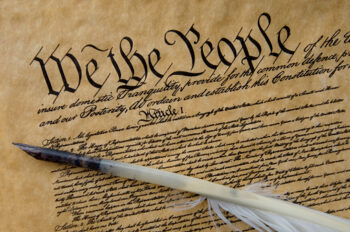
Then there is Chief Justice John Roberts who wrote the majority opinion. He must have been absent or sleeping on the first day of his constitutional law class as most such courses examine the founding document in the order it is written. One need go no further than Article I, Section 1 to understand that the organization and funding of the federal government resides in the legislative branch.
Section 1. All legislative Powers herein granted shall be vested in a Congress of the United States, which shall consist of a Senate and House of Representatives.
To then suggest, as Roberts did, that the duly enacted Federal Trade Commission Act, signed into law by Woodrow Wilson on September 26, 1914, which under 15 U.S. Code §41 states that a commissioner may “only be removed by the president for inefficiency, neglect of duty or malfeasance in office” is unconstitutional boggles the mind. What version of the constitution did Roberts use compared to the one a district court used to grant Rebecca Slaughter a permanent injunction based on “Ms. Slaughter’s right to perform her lawful duties?”
Next on the list, as seems to always be the case, is the GOP/MAGA majority in Congress. While a number of former Republican representatives and senators signed on to an amicus brief supporting Slaughter’s position, sitting GOP legislators did not challenge Donald Trump usurpation of their Article I, Section 1 powers. Quite the opposite. Senator Eric Schmitt (R-MO), who chairs the (drum roll) Senate Judiciary Subcommittee on the Constitution, submitted an amicus brief in support of Trump’s position, a move akin to handing the axe to the executioner at your own beheading.
Last on the list, once again, are the founding fathers who wrongly assumed anyone who rose to the position of president of the United States would faithfully abide by the checks and balances contained in the Constitution. Or as Jeffrey Engel, director of the Center for Presidential History at Southern Methodist University, adds:
The Founders expected the three branches of government to fiercely compete for power. They assumed Congress would automatically push back against an overreaching executive to protect its own prerogatives…The Founders created a system heavily reliant on unwritten rules and mutual consent.
In other words, the framers were guilty of an adage that plagues so much of what is wrong in the world. The road to hell is paved with false assumptions.
As Kate Shaw, a law professor at the University of Pennsylvania suggests in her essay in today’s edition of the New York Times, “When Mr. Trump leaves office, it will fall to the legislative branch to rebalance government power to better align with the Constitution’s design.” All Congress needs to do is reassert its Article I, Section 1 authority.
Furthermore, I believe Chief Justice Roberts nailed the issue in the opening sentence of his Trump v. Slaughter majority opinion.
The Federal Trade Commission (FTC) is a regulatory agency that has accumulated vast rulemaking, enforcement, and adjudicatory powers.
Roberts is only two-thirds correct. The FTC, like literally every independent regulatory commission, has rulemaking authority, with two BIG ifs. Any regulatory agency must be established by the legislative branch. And the nature and scope of its rulemaking authority MUST be authorized by Congress. But here is the opportunity that everyone seems to have missed. Rulemaking is an extension of policymaking which is not an executive function.
Neither is the FTC adjudicatory powers. It is akin to arbitration, more comparable to judicial proceedings than executive action.
Finally and most importantly, Roberts is dead wrong when he claims the FTC has “enforcement” powers. An independent agency has no police force. It cannot arrest anyone for violation of its rules. It relies on the executive, specifically the Justice Department, no different from Congress and the Courts, to enforce its regulations and responses to violations of those regulations (e.g. a fine or cease and desist order).
Since 1789, the courts have continuously affirmed it is Congress that holds the power to organize the federal government through the establishment and abolishment of entities including those in the executive branch (cabinet departments) and the judiciary (number and types of lower courts). The Constitution further bolsters this authority through Congress’ control of the national purse strings (raising revenue and authorizing spending).
Therefore, if independent commissions have responsibilities affiliated more with the legislative and judicial branches, why do they even fall under the executive branch? And if they are extensions of Congress’s policy function, putting meat on the bone of broader legislative directives, why are the members of independent commissions appointed by the president?
How ironic is it that, five days before the celebration of American independence, the Supreme Court declared June 29, 2026 as “Dependence Day?” Which suggests, this Saturday, the 250th anniversary of our nation’s separation from the Crown of England, we let Donald Trump have his faux celebration. This year, November 6, election day will feel more like Independence Day. Then, we the people can celebrate the beginning of our formal separation for the rule of King Donald and his supreme court jesters.
For what it’s worth.
Dr. ESP
The unitary executive theory is a constitutional law concept maintaining that Article II of the U.S. Constitution vests all executive power directly in the President. It holds that the President must have absolute, unilateral authority to supervise, direct, and remove all federal officers and executive agency personnel.
Roberts says THERE IS THE ANSWER!!!
You had me worried at first. I checked the sheepskin on my wall, and Mr Jefferson was still smiling at me.