
A problem well stated is a problem half solved.
Charles Kettering (1876-1958)
As I often remind readers, the best topics for a Deprogramming101 post come from the least expected places. And often begin with a great question. Today’s subject was triggered by a random Facebook conversation initiated by “Only in South Florida.” It included a photo of a dining receipt in which the patron, objecting to the recommended tips for his/her $612.73 food, beverages, tip and tax (18 percent/$110.29 to 22 percent/$134.80), left what seemed like a miserly gratuity of (drum roll) $9.00. The merchant’s copy included a lengthy explanation of the patron’s actions.
To everyone acting like tipping rules are written in stone, let’s talk about it. I had a $612 dinner bill, and suddenly, I’m “supposed to leave over $120 just because the total was higher? Same plates carried, same drinks refilled, same amount of time at the table–but somehow the menu prices decide the server’s pay?
As you might imagine, this non-monetary tip got the restaurant manager’s attention. The patron reports she was given a lecture on “industry standards, “as if that would settle the whole debate.” It was the patron’s response to the concept of “industry standard” that caught my attention.
Since when does a more expensive meal automatically mean more effort? If I order a $50 entree instead of a $20 one, does the plate suddenly weigh more? I do tip for good service. But I don’t think a tip should automatically become a percentage-based surcharge.
It made me think about extreme situations. I sometimes go to dinner with friends when I am not particularly hungry and order soup/salad or an appetizer as my main course. I don’t ever recall the wait staff paying less attention to me than others at the table, confirming “Only in South Florida’s” perspective. They did not exclude me when asking if anyone needed something else, they brought the meal at the same time, made sure all our water classes were full, and processed my credit card for my share of the dinner just like everyone else.
Similarly, the percentage-based tip makes little sense when diners ask for separate bills. There is no difference in the quality of service if one couple orders the often premium-priced daily special and another couple splits a lesser priced entree. The wait staff exerts the same effort for each set of customers.
My thoughts then turned to my experience in Milan last fall. I returned as an adjunct professor at the Catholic University of the Sacred Heart after a five year hiatus. Fortunately, several of my favorite restaurant along Via Dante survived the pandemic. Something, however, had changed. As in much of Europe, tipping was still not expected, though an extra Euro or two was encouraged for exceptional service. This time, many of the restaurants now included a coperto, a per-person service charge, generally a flat fee of one to four Euros regardless of the meal’s price. I had no problem with the upcharge, since, even in the finest of restaurants, the cost of a multiple course dinner was significantly less expensive than what one would pay for a comparable meal back home. [NOTE: Under Italian law, a customer may ask the coperto be deleted from the bill if it is not clearly listed on the menu.]
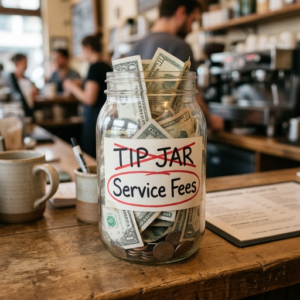
Which brings me to the premier rule in the Dr. ESP guide to effective management. Management and staff can always point out what they think is wrong, if and only if, they present a constructive alternative to resolve the issue. Instead of lecturing “Only in South Florida” about industry standards, the restaurant manager could have asked, “Do you have any suggestions about a fairer way to assess customers for the service they receive?” Based on my own observations and experiences abroad, maybe it is time for a new “industry standard.” The following is one alternative.
- Assess an “occupied seat” flat fee. I made the distinction between “occupied seat” and “per person” because an occupied seat has an opportunity cost for the restaurant and the employees, even if the individual orders nothing to eat or drink.
- Options for setting the flat fee include but need not be limited to:
- The mean per-person receipt for food and beverages based on historical data. Establishments that serve breakfast, lunch and dinner could set a different flat fee for the times during which each meal is offered.
- Authorize a committee of industry representatives to set guidelines for the flat fee based on, but not limited to, the following: meal offerings, level of service (fast food to full-service), dine-in versus carry-out, and cost of living in the restaurant’s location.
- Similar to the Italian law, require restaurants to inform customers of the fee on in-restaurant menus and on-line, especially web sites on which customers can order food and beverages.
- Customers may, at their discretion, leave an additional gratuity based on exceptional service or a service not normally offered on the menu (e.g. birthday celebration or table decorations).
As always, the above suggestion is provided as a conversation starter. There may be more equitable options which require less administrative burden on a food establishment. However, nothing will change unless we heed “Only in South Florida’s” request, “Let’s talk about it.”
For What It’s Worth
Dr. ESP
Why not just charge for the meal what the establishment needs to cover it’s expenses, profit and wait-help salaries?
And pay a employees a decent wage. Many restaurants only pay minimum wage because they know the wait-help is going to get tips.
Of course, then the meals would seem too expensive. Meal prices can seem lower when the patrons are actually paying the employees salaries and think nothing of it.
Service fee would go toward higher wait staff salaries since it is collected by the restaurant, not tagged to an individual server. The point of the service fee is to let the customer know that the higher total (meal + fee) covers both food and labor
Remember “No tax on tips”? I suppose it might be fair to say, “Garcon, assuming you are in the 20% tax bracket; I have reduced your tip by 20% and you have broken even.”
On the other hand, anyone who can afford a $600 dinner should have enough smarts to do a quick cost/benefit analysis and say to theyself before ordering or, perhaps, even before making the rez, “Is this meal worth $720?” Maybe figure in the state and local taxes, too. Now you’re north of $750.
Still hungry?