
A January 12, 2026 Gallup press release reports a record high 45 percent of adults in the United States identified as “political independents” in 2025, two percent higher than the previous record set in 2024. In contrast, the remaining adults were evenly split between Democrats and Republicans with 27 percent each. There has been no lack of attention to this disaffection with the two-party system. Both major parties have produced “autopsies” following disappointing election outcomes. News networks and the op-ed pages of every newspaper are peppered with analyses related to this phenomenon.
Based on voter surveys, the primary reason for this decline in party membership centers on both parties’ trend toward more and greater ultra-partisanship. At the same time, ideological identification in the U.S. has shifted over the last three decades. In 1992, a plurality of adults (43 percent) described themselves as “moderate.” By 2024, that number decreased to 34 percent. Over the same period, Americans who self-identified as “conservative” remained relatively constant, fluctuating up and down between 40 and 36 percent. Conversely, the percent of adults who classify themselves as “liberal” climbed steadily from 17 to 25 percent. (Source: Gallup Organization)
Which brings us to the age-old question, “Which came first, the chicken or the egg?” Did the two major parties become more partisan following a shift in ideology among their respective base voters? Or did a wider ideological gap between Democrat and Republican agendas precede realignment of voters’ own ideological preferences? Please do not get mad at me when I tell you it does not matter. Why then would I waste three paragraphs to focus on this topic? To once again demonstrate how political discourse is too often dominated by noise, while ignoring the signal. The noise versus signal metaphor has no definitive point of origin. “Shark Tank” panelist Kevin O’Leary offers the following description. “It requires identifying your most vital goals or metrics (the signal) and systematically eliminating or ignoring all irrelevant distractions, minor tasks, and interruptions (the noise).
[BLOGGERS NOTE: Many unfinished drafts serve to simply get unresolved thoughts out of my head. That was the case this morning until the Bureau of Labor Statistics released its report on May 2026 inflation.]
It is 8:30 am Wednesday morning. An AP News alert popped up on my screen. “Inflation rises to a 3-year high on spiking gas prices, highlighting affordability challenges.” In less than a hour social media is flooded with sound bites. Republicans claim the increase does not repudiate the eventual benefits of Trump economic policies. They are tossing the usual sound bite grenades. Short-term pain for long-term security. The core inflation rate, which excludes the cost of food and energy, is what matters, not consumer prices. The stock market is at record highs. Democrats are equally grounded in their own sound bite vocabulary. Reckless conflict in Iran. Working families are “paying the price” of Trump’s agenda. Wall Street versus Main Street.
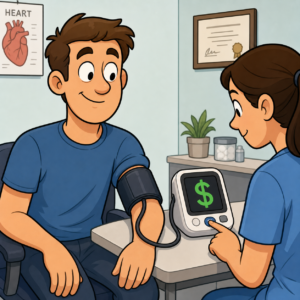
What then is the possible connection between the increase in independent voters, the widening gap in ideology, and both parties’ reliance on sound bites? For me, the answer emerged last Friday when I saw a Facebook post by a local Democratic candidate whose promised, if elected, “free health care.” I happened to see the candidate the next day, and asked, “Do you really think health care can be free?” Response? “Yes, like Medicare.” Did I really need to remind the candidate that I paid into the trust fund for 45 years, and the government continues to take $208/month out of my social security benefits to cover Part B? Medicare is not free health care! One of the candidate’s supporters then told me she, being a veteran, got free health care through the Veteran’s Administration. Maybe GI bill benefits are not a cash transaction, but they are still earned through service to one’s country.
The candidate then pivoted, claiming health care could be fully-funded with savings from an audit of the Defense Department and by taxing billionaires. I suggested affordable (not free) health care would require more than new sources of revenue. It would also require fundamental changes in the delivery and pricing of health services. Even after I told her I thought a single payer health care system similar to those in other industrialized nations made sense, the supporter called me a skeptic and said I knew nothing about health care.
Even though I am a registered Democrat, like many independents, I am an economic moderate with largely left of center social values. If the Democratic Party wants to retake control of Congress in November, candidates cannot win based solely on turnout by registered Democrats, even in unprecedented numbers. Exit polls in every 2025 off-year and special election show over performing by Democrat candidates resulted from coalitions of Democrats, disaffected non-MAGA Republicans and moderate independents who realized they had been conned by Trump’s faux populism platform.
If the polling is correct, they are looking for solutions, not sound bites. The challenge for Democrats to close the deal in November? Some solutions (e.g. a single payer health care system) may be hard to swallow and will require fact-based education to garner the necessary public support and congressional approval. Since my epiphany was based on the issue of affordable health care, I’ll use that as an example. As previously suggested, both parties have great sound bites when it comes to financing health care. Tax breaks in the form of enhanced health savings accounts (Republican). Tax billionaire and eliminate waste in the defense budget (Democrats).
Neither solve the problem. Without changes in the health care system, GOP-supported tax-free savings accounts will quickly run dry as the price of insurance premiums and health care services continue to rise. Democratic proposals to shift funding priorities (e.g. cutting the defense budget) and a wealth tax on billionaires sound good but the numbers do not work.
- Total U.S. health care spending is $5.3 trillion annually. (Kaiser Family Foundation)
- Although the Pentagon has not had an official financial audit, estimates of waste in the defense budget vary depending on who does the accounting. Even the best estimates represent about one percent of annual health care costs.
- Elon Musk’s DOGE found there was only $80 million wasted on “programs that do not support DOD’s core mission.” (I’m still laughing.)
- A January 2025 report by the Stimson Center, a nonpartisan D.C. think tank, recommended over $60 billion in potential savings.
- The 989 billionaires in the U.S. have a combined net worth of approximately $20.1 trillion. (Source: Forbes) Factoring in the DOD waste contribution to annual health care costs, funding the remainder would require an annual 25 percent tax on billionaire wealth. Therefore, the primary revenue source for “free health care” would rapidly decline and effectively disappear within a decade.
If only the candidate and supporter had asked if I had any ideas how to make a single payer system workable, I would have shared a recent experience overseeing a family member’s recent hospitalization. The hospital billed the Medicare provider $19,752. The adjusted insurance payment was $2,689. The co-pay was $401. In other words, the hospital accepted a total of $3,090 for services with a “rack price” of almost $20,000, a discount of 85 percent. If one of the 50 parent insurance companies that offer Medicare advantage plans for over 35 million seniors can negotiate an 85 percent discount for health care services, imagine what a single payer system representing 10 times as many subscribers could do.
It still would not be free. Everyone would have to pay something into the single payer trust fund. Equally important, it should NOT be free. Every beneficiary should have financial “skin in the game” when it comes to their health care, even under the most progressive contribution formula.
Is single payer with a progressive contribution schedule the answer? I do not know. What I do know is voters are tired of sound bites. “Make America Great Again” and “Tax the Rich” are lazy substitutes for the hard work required to win back voters’ faith in the political process. The party or independent candidates who demonstrate their commitment to doing their homework will likely carry the day.
For what it’s worth.
Dr. ESP
Your very best work Professor! Kudos!
If a Medicare clone is free, then I want my pre-paid premiums back.
If student loans a written off, then I want the private-pay tuition back that my parents worked their butts off to pay.
…and so on, etc.