

[BLOGGER’S NOTE: In addition to being the 250th anniversary of the signing of the Declaration of Independence, today also marks a milestone for Deprogramming101. Today’s post is the 1,000th entry on this site going back to October 2015. As always, thank you for your interest and support for this effort.]
One activity authorized by the bipartisan congressionally-created America 250 committee is a 900-pound stainless steel time capsule to be opened on the quincecentennial in 2276. Now that’s what I call optimism. The cylinder will reside underground at Independence National Park in Philadelphia and contains artifacts from all 50 states. (If Donald Trump’s alternative Freedom 250 committee of one had been in charge, the capsule would also include items from Venezuela, Cuba, and Greenland.)
I doubt even a modern day Nostradamus could accurately describe what America will look like 250 years in the future. However, of one thing I am sure. To not coin a phrase, it will be the best of times and the worst of times. How do I know? HISTORY.
To understand the good times, one must start with the bad times. From the moment the ink dried on John Hancock’s John Hancock the achievements of which Americans are most proud were birthed in response to our union’s most egregious transgressions, with slavery, America’s original sin, at the top of the list. But this was just one of many issues to resolve in order to validate the founding fathers’ promise of life, liberty and the pursuit of happiness for all, the first being the system of government to support that ideal. Remember, the Constitution was not waiting in the wings to debut immediately after Benjamin Franklin, John Adams, and John Jay signed the September 3, 1783 Treaty of Paris, the official end of the Revolutionary War. The framers’ memory of George III’s tyranny initially led to the Articles of Confederation, an overly weak governmental framework, which deprived the central government of the the ability to regulate interstate commerce, raise revenue and raise a national army. Equally important, any modification required unanimous consent.
Fortunately, flaws in the Articles of Confederation were apparent almost immediately, and within less than five years, New Hampshire, on June 21, 1788, became the ninth state to ratify the U.S. Constitution, satisfying the lesser threshold of two-thirds of the states to adopt or amend the document. Only after implementation of this second attempt at self-government was tested under fire, during the War of 1812 and Civil War, did Abraham Lincoln’s vision of a “government of the people, by the people, for the people, shall not perish” appear to be more than a pipe dream.
I know what you’re thinking. Dr. ESP, thanks for the history lesson, but what has this got to do with something you are calling the 50-year itch? What is it? Who has it? And why is it so important that you chose this topic on such a auspicious occasion?
The short answer? The 50-year itch is about the framers’ foresight to include a structure of checks and balances and how, every five decades, the executive branch yearns to test the arrangement.
The first appearance of this malady was the Tea Pot Dome scandal, which historian Robert Cherney describes as “pre-Watergate, the greatest and most sensational scandal in the history of American politics.” Ironically, then president Warren G. Harding was not the central character. Recognizing the growing demand for oil versus coal after World War I, Interior Secretary Albert Fall convinced Harding he should oversee the leasing of federal lands. Wasting no time to personally profit from this new authority, Fall granted the lease for the oil reserves at Teapot Dome, Wyoming to Mammoth Oil and the one for Elk Hills, California to Pan-American Petroleum. In April 1922, the Wall Street Journal reported that Fall received $400,000 from the presidents of the two companies, Harry Sinclair and Edward Doheny, respectively.
The congressional and judicial response was swift and far reaching.
- Following a Senate investigation, Sinclair was found guilt of contempt of Congress for refusing to testify and served six and a half months in prison.
- In response to Sinclair’s challenge of Congress’ subpoena power, the Supreme Court affirmed the legislative branch’s right to compel testimony and conduct investigative oversight (Sinclair v. United States 1929).
- The investigation provided justification for the Supreme Court to cancel the leases.
- Congress expanded its investigative powers including access to IRS tax records of private citizens.
That response should have been a warning to future chief executives. However, as we learned on June 16, 1972, 50 years after the Wall Street Journal exposé, Richard Nixon’s White House suffered a severe case historical amnesia. For purposes of this discussion, I will forego the list of crimes resulting in Nixon’s resignation and criminal convictions of 48 administration and campaign staff. Again, it is the legislative and judicial response to Nixon era transgressions that should have set the parameters for future presidents.
- The Federal Election Campaign Act Amendments (1974) limited political expenses and contributions with strict reporting requirements.
- The Congressional Budget and Impoundment Control Act (1974) prohibited executive cancellation of congressionally appropriated funding. It also created the Congressional Budget Office as an independent source of fiscal analysis for lawmakers.
- The Ethics in Government Act (1978) mandated financial disclosure forms for the president, vice-president, and senior officials in the executive branch. It also authorized the independent counsel process to investigate executive branch misconduct.
- The Privacy Act of 1974 gave every citizen the right to review and amend any of their personal information held by the federal government.
- Amendments to the Freedom of Information Act (1974) reaffirmed the public’s right to access government records and established strict deadlines for responding to FOIA requests. It also gave federal judges the right to review the classification of federal documents.
- In the case of United States v. Nixon (1974), the Supreme Court unanimously ruled a president cannot use executive privilege “to withhold evidence that is demonstrably relevant in a criminal trial.”
Flip the calendar to November 2024, just three months after the 50th anniversary of Nixon’s August 8, 1974 resignation. There lies the next iteration of an evolutionary process by which United States presidents test the waters of the framers’ system of checks and balances. And the direction of that evolution is irrefutable. Each time the sitting president attempts to take a bigger and bigger chunk out of that constitutional firewall. However, as president historian Jeffrey Engel writes, the framers believed all three branches of government would aggressively compete to protect their constitutional authority. And in the cases of above, Engel was correct. In a July 5, 2020 op-ed, POLTICO deputy editor Cory Bennett wrote:
Watergate has long been told as a story of American exceptionalism. The system of checks and balances and public oversight worked. The Constitution triumphed over leaders who abused their power. Through a combination of dogged criminal investigators, serious oversight by Congress and sustained public attention, the wheels of accountability ultimately turned even for the president of the United States.
Which brings us to Donald J. Trump. Again, I could waste your time enumerating his attacks on the Constitution, the rule of law, democracy and common decency. America’s future depends less on his sins than the response. The last sentence of the above quote would be a could place to start. As of today, there are no “dogged criminal investigators.” There is no “serious oversight by Congress.” Nor for that matter by the Supreme Court. Both the legislative and judicial branches are better depicted as enablers than rivals. Which leaves us with “sustained public attention.”
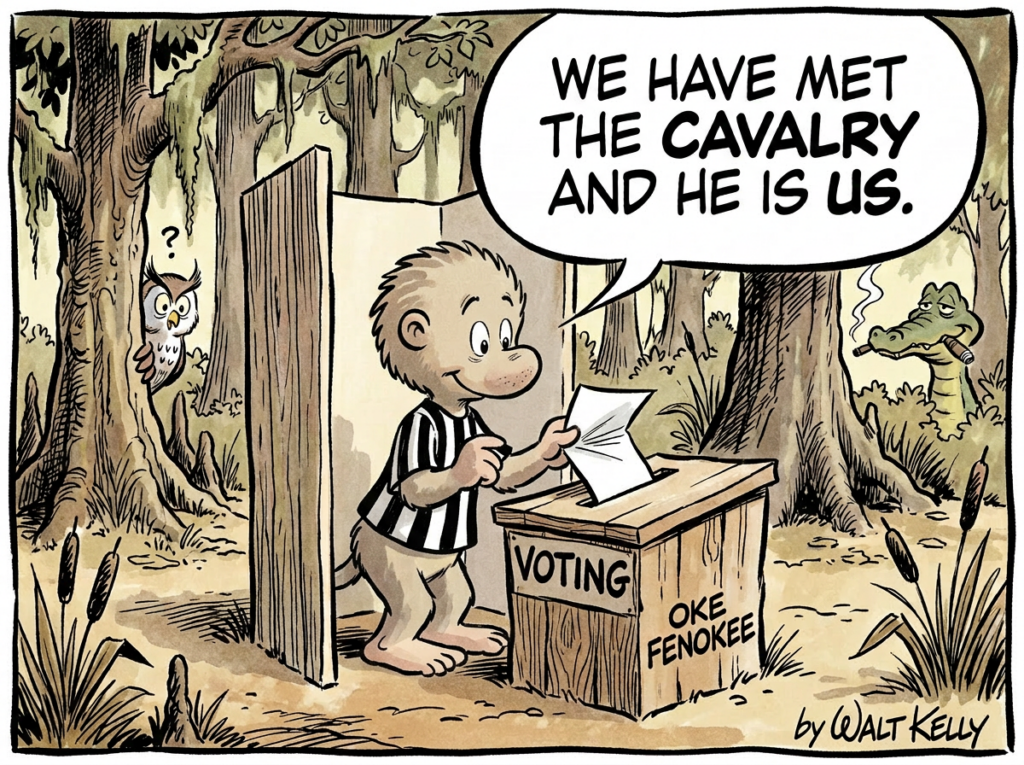
Pogo said, “We have met the enemy and he is us.” That is certainly accurate when it comes to the rise of Trumpism and the 77,302,580 voters who thought DJT and MAGA were the remedies for the nation’s ills. However, if the polls are correct, that number now exists only in the rearview mirror. Which suggests, if Walt Kelly were still with us, he might revise his most famous cartoon as seen here.* We are the only ones who can save ourselves from this most recent return of the 50-year itch. As Syracuse University political science professor Kevin Gottlieb so elegantly capsulized the role of public discourse and dissent, “When politicians feel the heat, they see the light.”
Happy 4th of July. And best wishes for more, happier ones in the near future.
For what it’s worth.
Dr. ESP
*Image created with Adobe Firefly/2026 (cc) Joseph Kayne
Doc – DJT’s Grammar Squad is going get you for that last paragraph. Ain’t no such thing as more happier; but we can surely hope for it
Thanks, Slick. I intended it to read “more, happier ones in the future”. I’d blame it on the proofreader, but I did not have a mirror with me. It has been corrected.