
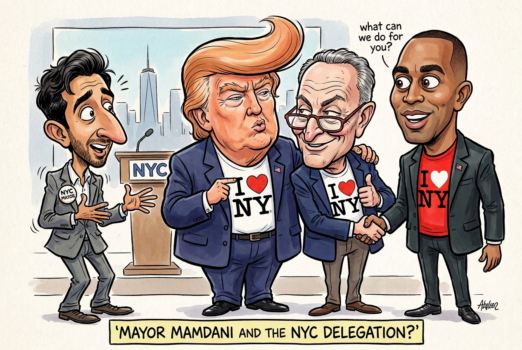
One could argue the 2026 Midterm elections were about decentralization of power to restore the checks and balances envisioned by the drafters of the U.S. Constitution. What precipitated this backlash? Was it a Supreme Court that ruled, in the 2024 case of Trump v. United States, a president is presumed immune from prosecution for official acts? Was it a GOP/MAGA majority in both houses of Congress which abdicated its Article I authorities to declare war, control the purse strings of the nation’s treasury, and conduct legitimate investigations of the executive branch? To paraphrase Rear Admiral David Farragut at the Battle of Mobile Bay in 1864, was it a president whose modus operandi was, “Damn the Constitution and rule of law! Full speed ahead!”? Or was it something more esoteric, the electorate’s tiring of performance art over competent governance, vulgarity over civility, and personal interests over public service.
Regardless of the underlying causes, voters spoke loudly and clearly that, at least for the next two years, consolidation of power by one branch of government, much less by one individual, was no longer the order of the day. What we will find on January 3, 2027, however, is an unprecedented geographic concentration of federal leadership. When Congress reconvenes in January, for the first time in American history, the president, speaker of the House, and Senate majority leader will have been born and bred in the same city, in fact, within an 11-mile radius of each other. Hakeem Jeffries lives in the Prospect Heights neighborhood of Brooklyn. Chuck Schumer resides in the Park Slope area of the same borough. And before his parents parents shipped him off to the New York Military Academy, Donald Trump spent his early years in the affluent Jamaica Estates section of Queens.
If Neil Simon was still alive, the frontrunner for the 2027 Tony Award next fall might be “The Odd Throuple,” To paraphrase the opening for the television version of Simon’s two-person variation asked, “Can a white narcissist from Queens, the Jewish grandson of Ukrainian immigrants, and the black son of a father who was a substance-abuse counselor share a government without driving each other crazy?” And suppose, instead of the flirty British sisters–Gwendolyn and Cecily Pigeon–occupying an upstairs apartment, the newest tenant is the Muslim, Democratic Socialist mayor of New York Zohran Mamdani. In a most ironic twist of fate, Mamdani is the one person who develops a working relationship with all three members of the Potomac River triad.
The implications of this vortex of power are uncertain, especially if you go back to the time when NYC was the nation’s capital for the first 16 months following ratification of the constitution. The relocation to Philadelphia and eventually Washington, D.C. resulted from Thomas Jefferson’s concern that a less central site for the federal government would prove overly advantageous to New England and Northeastern states. Between 1933 and 1974, New York City was the beneficiary of federal funding for public works projects during the depression and as a model for urban renewal under The Great Society. That period of amity ended in 1975 when the city faced potential bankruptcy and Gerald Ford hesitated to intervene on its behalf, leading to the infamous New York Daily News headline, “FORD TO CITY: DROP DEAD.”
Despite its own fiscal troubles, New York City has always been a net tax contributor to the federal government. According to the most recent available numbers (FY2024), the state of New York generated $353.5 billion in federal taxes (7.4 percent of the U.S. total) while receiving $341.1 billion in federal spending. Of that, New York City accounted for 59 percent of the state total. Therefore, the last thing Treasury Secretary Scott Bessent wants to see on the front page of the Daily News is, “Mamdani to Feds: Drop Dead.”
All of which explains why the Big Apple, home to the three most powerful men in D.C., has a lot to look forward to during the last two years of the Trump administration. Congressional leaders Schumer and Jeffries will both be running for reelection in 2028. And there is nothing more tangible than federal public works projects to demonstrate the value of being in a leadership position to produce a pork barrel bonanza. On the other hand, Mamdani knows that Trump has always felt that New Yorkers have never viewed him as a player. By giving Trump just the slightest taste of that honey, Mamdani has convinced the president to partner with the city to give bodegas a 90-day extension of new rules which require these corner markets to stock a variety of products in each of the major food groups or lose their ability to accept SNAP benefits as payment. Trump now supports the major housing project at Sunnyside Yard in Queens, which will add 12,000 housing units in the borough. And NYC is the one jurisdiction where Trump has used the a-word (affordability), saying he will cooperate with the Mamdani team to reduce the cost of living for Gotham residents.
Unfortunately, if you are mayor of Baltimore, Maryland Brandon Scott, do not expect similar treatment. At least, not until 2029, when. who knows, Maryland Governor Wes Moore might be president, Senator Chris Van Hollen could be majority leader, and Representative Jamie Raskin runs for Speaker of the House. As any realtor will tell you, the key to selling is, “Location! Location! Location!”
For what it’s worth.
Dr. ESP