
There is a scene in Milos Forman’s 1984 adaptation of the Peter Shaffer play “Amadeus” when Emperor Joseph II (Jeffrey Jones) first meets Wolfgang Mozart (Tom Hulce). The young prodigy demonstrates his ability to improvise by playing his own rendition of Antonio Salieri’s “Welcome March,” which Salieri, the court composer, had written to honor his benefactor. The emperor then gives his review.
JOSEPH: An excellent effort! You’ve shown us something quite new today.
MOZART: (very excited) It is new, it is, isn’t it, Sire?
JOSEPH: Yes, indeed.
MOZART: So then you like it? You really like it, Your Majesty?
JOSEPH: Of course I do. It’s very good. Of course now and then – just now and then – it gets a touch elaborate.
MOZART: What do you mean, Sire?
JOSEPH: (after conferring with Count Orsini-Rosenberg) Too many notes.
MOZART: I don’t understand. There are just as many notes, Majesty, as are required. Neither more nor less.
JOSEPH: My dear fellow, there are in fact so many notes the ear can hear in the course of an evening.
What triggered remembrance of this scene from a film I first saw 42 years ago? Scottie Scheffler. After a 2026 debut worthy of the world’s #1 ranked golfer, winning the American Express and finishing tied for fourth at the Pebble Beach Pro-Am, Scheffler seems to be losing his touch. A tie for 12th at the Genesis Invitational. A tie for 24th at the Arnold Palmer Invitational. And after two rounds in the Players Championship, he began play this morning tied for 51st, 13 strokes behind the leader Sweden’s Ludvig Åberg.
Scheffler’s success is the result of an unconventional swing as explained by golf professional Jack Backhouse.
Scheffler stands with quite a wide stance, which you can imagine is necessary to be able to remain standing with his crazy leg action post-impact!
Scheffler doesn’t achieve much hand depth at the top of the swing, which is contrary to what a pro would teach an amateur golfer.
Scheffler drives his legs and hips towards the target more than any other golfer on any professional tour. The effect of this is that Scheffler is able to swing down without his shoulders opening too much, stopping his hands from getting too far outside and keeping his impact very neutral.
Whereas in all the other winner’s swing analysis I’ve done, the professional finds themselves in a lovely balanced position at the end of the swing. Scottie Scheffler laughs in the face of a balanced follow-through. His feet routinely slide all over the place, depending on what type of shot he is attempting.
There are a lot of moving parts in Scheffler’s swing. Some analysts might opine there are too many or too few. However, since he is the #1 golfer in the world, I can imagine Scottie thinking, if not saying it out loud, “I don’t understand. There are just as many moving parts as are required. Neither more nor less.” And when everything is in sync, he is absolutely right.
Over the last two days, it appears something is out of sync. He is over-fading his drives. Pulling his short irons. The velocity of his swing does not match the perceived distance between his lie and the flag pin. Despite his lackluster showing two weeks ago, everyone expected he could make the necessary adjustments on the practice range and be the odds-on favorite to win his third Players Championship. He has not. With so many moving parts, each presents the chance of an unintended and unwelcomed variation.
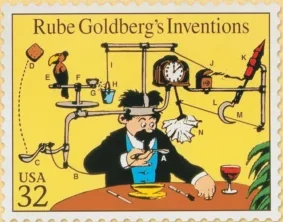
Which brings me to the reason why today’s blog post is unique. It is a metaphor within a metaphor that helped me better understand the topic I came here to talk about. The war with Iran. ln one sense it is a musical composition that needs just the right number of notes. It is also a golf swing with many moving parts which must remain in sync for a golf ball to land close to the flag stick.
First, we need to reconsider Emperor Joseph II’s suggestion that “there are in fact so many notes the ear can hear in the course of an evening.” It may have been wrong for Mozart, but it explains perfectly why Americans are so confused about the motivation for or what constitutes success when it comes to “Operation Epic Fury.” There are more explanations “than the ear can hear in the course of an evening.” Obliterate Iran’s nuclear capability, AGAIN. Regime change. Liberate the people of Iran. Netanyahu made me do it. Hell, the president and his cabinet do not even know what to call it. Is it a WAR? A limited operation? A precision aerial attack? Or, as Trump most recently repeated constantly, an “excursion?” [NOTE: Nothing explains the Trump administration more than the fact that not a single member of his cabinet, inner circle or family have the cajones to tell him the word is “incursion,” not “excursion,” which, as we all know, is something you pay extra to do on a cruise or guided tour.]
And finally, there is the battle plan. Even with the best of planning, there are no guarantees. Just ask Prussian Field Marshal Helmuth von Mulke (1800-91) who said, “No battle plan survives contact with the enemy.” There should be a similar maxim for golf. “No swing survives contact with the terrain.” That is why you will hear golf analysts say they are surprised at a player’s poor performance after watching the same player on the practice range. In the latter instance there are no downhill or sidehill lies. There is no rough. And you never find your ball in someone else’s divot. That does not mean you should not anticipate such circumstances. For example, every professional will practice an intentional fade or hook just in case they need to avoid a tree that inconveniently chose to position itself between them and the green.
So, when it comes to warfare, you also do your best. You test and retest every moving part. Prepare for the best, anticipate the worse and have Plans A to Z in your back pocket to address each and every contingency. You want to be a Mozart playing just the right number of notes in the correct pitch and tempo. Or a Scottie Scheffler who, when all his moving parts are in sync, executes his game plan with perfection.
If the first two weeks of this high-priced “excursion” into the Middle East are any indication, I can imagine the ghost of the late Texas senator and vice-presidential candidate Lloyd Bentsen telling Donald Trump, “I knew Mozart and Scheffler. Mozart and Scheffler were friends of mine. Donald, you are no Mozart or Scheffler.”
For what it’s worth.
Dr. ESP
Well said. Just the right number of words…
Funny, most people accuse me of writing the LEFT number of words. Thanks.